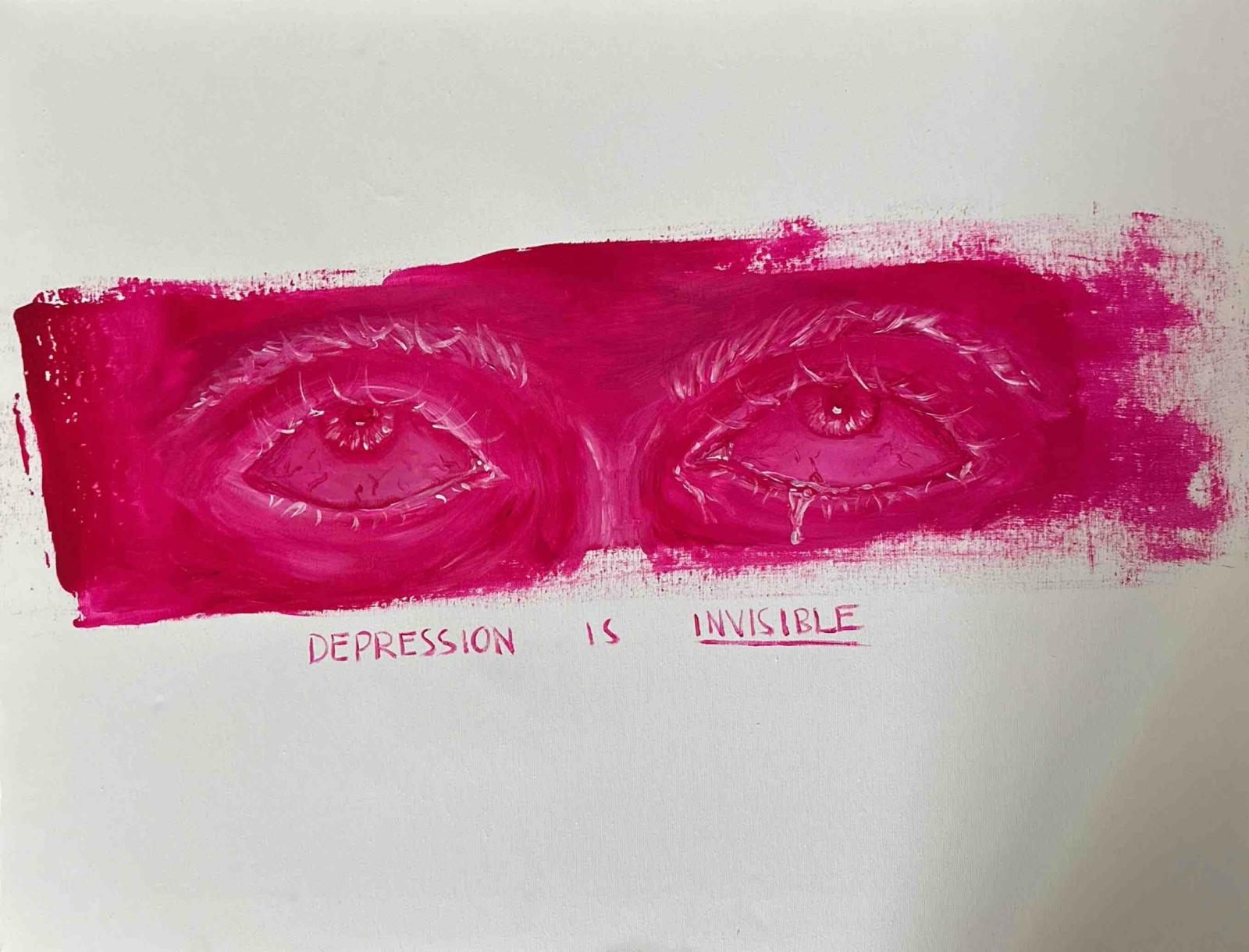

In Depression Is Invisible, artist Andrea Carrozzo strikes us straight to the heart with a powerful and immediate work. The eyes take center stage, peeking out from a chaotic and suffocating background of colors.
The brushstrokes are so bold they appear to be wounds on the canvas. The magenta-red dominates the scene and screams out all its visceral energy, while the white details make the gaze incredibly three-dimensional and defenseless. That tear falling is not a fiction, but the sincere tale of a pain held back for too long.
The true stroke of genius is the contrast between the words and the image. The title suggests that depression cannot be seen, but the painting forces us to look it in the face. The stripe of color on the face is a double-edged mask: it hides but, at the same time, reveals the most fragile part of us. It is the perfect portrait of our times, in which we often mask suffering behind a false perfection.
With an emotional charge reminiscent of Munch's famous Scream, Andrea Carrozzo transforms personal anguish into a universal message, demonstrating that art can give voice to the deepest states of mind.
More information:
On display at the Dantebus Gallery in Florence from May 9 to June 10, 2026
Dantebus Gallery Review
Andrea Carrozzo's "Depression is invisible" captures the viewer with a powerful
expressive urgency. The eyes—the mirror of the soul—are the only protagonists, emerging from a mass of color that oppresses and reveals. The brushstroke etches the canvas like an open wound.
The bright and visceral magenta-red gives no respite to the gaze: it is a scream. The white, used to outline the eyes, introduces a luminous tension that accentuates the three-dimensionality, making the gaze more vulnerable. The shining eyes become witnesses. The falling tear is not a melodramatic gesture, but a minimal and definitive sign of suppressed suffering. The core of the work lies in the paradox between image and word.
The words "Depression is invisible" declare the invisibility of an illness that, here, becomes impossible to ignore. The stripe of color acts as a mask and a barrier: it hides the face, but at the same time exposes its most fragile side.
It symbolizes a contemporary condition in which inner pain often remains hidden behind a seemingly intact surface.
This tension between direct expression and emotional charge evokes Munch's ability to transform anguish into a universal image: painting reveals and shares a state of mind.